
Fetal Infant Mortality Review & Prevention
Fetal Infant Mortality Review (FIMR) teams are composed of diverse professionals who convene to analyze the root causes of fetal and infant deaths in their local areas. Through identifying the factors leading to each fatality, our team can create joint strategies for prevention, address racial and ethnic gaps in birth results, and enhance maternal well-being.
Thurston County is the first county in Washington State that is working to review fetal and infant deaths and is funded by the National Center for Fatality Review & Prevention.
Please contact Lisa Ostler at PHSS_FIMR@co.thurston.wa.us with questions about the structure of FIMR in Thurston County.
Sharing your story can honor your baby’s life and may help save the lives of others.

Support & Prevention
If you recently suffered the loss of a baby during pregnancy, after birth or up to the first year of life, the Fetal Infant Mortality Review (FIMR) Program of Thurston County would like to extend our deepest sympathy. Your experiences are unique to you and your family. Sharing your story can provide vital information about your experiences with registered nurses that would otherwise never be known. The Thurston County FIMR team would like to hear your story and support you in your journey. By sharing your experience, you can help improve future pregnancy outcomes and infants lives in the community.
Why Should I Share my Story?
Your story will help create changes in community services such as:
- Increase awareness about infant loss through education
- Improve healthcare systems
- Policy changes
- Creates helpful resources for patients and families

We want all babies to sleep safely. Each year, more than 3,500 U.S. infants die suddenly and unexpectedly. Many of these deaths occur in an unsafe sleep environment. The tools and information below follow the American Academy of Pediatrics 2022 Recommendations for a Safe Infant Sleeping Environment
The ABCs of Safe Sleep
We want all families to follow the ABCs of infant safe sleep: alone, on the back, in a crib or Pack ‘n Play®, and in a smoke-free environment. Intended for parents and families with infants, this video provides an overview of safe sleep best practices from the perspective of a new mom.
Resources
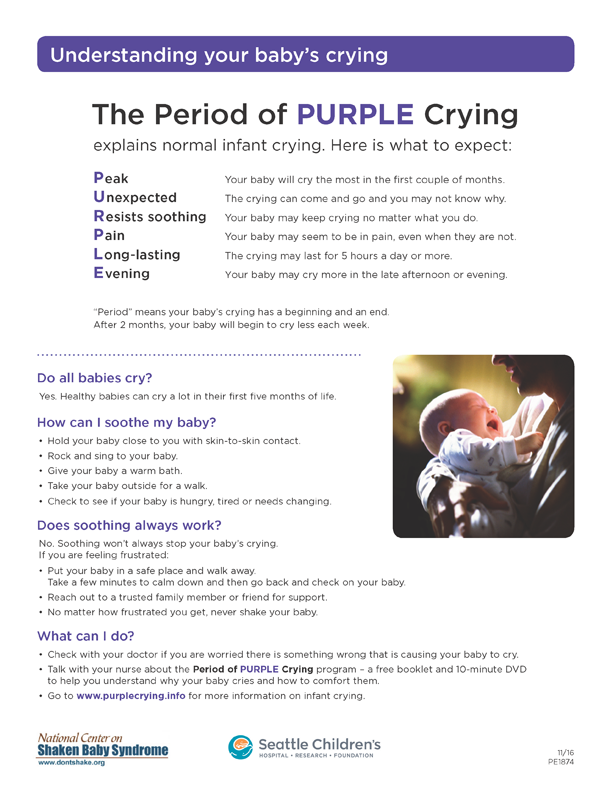
The letters in PURPLE stand for…
- Peak of crying. Your baby may cry more each week, the most in month 2, then less in months 3–5.
- Unexpected. Crying can come and go and you don't know why.
- Resists soothing. Your baby may not stop crying no matter what you try.
- Pain-like face. A crying baby may look like they are in pain, even when they are not.
- Long-lasting. Crying can last as much as 5 hours a day, or more.
- Evening. Your baby may cry more in the late afternoon and evening.
The word “period” means that the crying has a beginning and an end.
If you are worried something is wrong with your baby, check with your doctor.

Resources
- Don't Shake | PURPLE Crying (National Center on Shaken Baby Syndrome)
- Period of Purple Crying (Seattle Children's)
Educational Materials
Helping Grieving Families
Here are a few tools and resources to help take care of yourself and your family during your journey of grief.
Fetal and Infant Death Data
Fetal and infant death data provide key information about maternal and infant health. They are important factors in understanding a population’s overall health. Data on fetal and infant deaths help us track and understand health trends. The data highlight inequities that exist by geography, social and environmental exposures, and demographics, especially race and ethnicity. The data on fetal and infant deaths help us discover and evaluate preventive strategies to improve maternal and infant health.
Please contact us at (360) 867-2500 or email PHSS_FIMR@co.thurston.wa.us for general inquiries. This email is not monitored 24/7, please do not disclose any personal health information as this email is not HIPAA compliant.